All posts by michael1947

Holy spirit: our father which art in heaven

A Translation Problem #14

The New Testament was codified over several centuries through a gradual process of spiritual discernment, use in worship, and debate. The 27 books we know today were first officially listed together in 367 AD and finalized through a series of church councils by the early 5th century

The books of the New Testament are much easier to date than the Old Testament. They were obviously all written after the death and resurrection of Jesus in 33 AD and were mostly in their completed forms by 100 AD, when Christian writers began referencing and quoting from them.  Yet, these translations were taken from an oral tradition in Jesus’ Aramaic language, then into Peshitta, Hebrew, Greek, Latin, and onto other languages. Each translation created changes because of linguistic and cultural issues, as well as, early Christian Church battles over “acceptable” theology, dogma, and rituals.

There is some dispute about the exact dating of the Gospels (most of which were oral testimony written down after the fact) and most of the epistles. 

The compilation of these texts into a unified canon involved several key milestones:

  • Book of Matthew: After 70 AD, preserving oral accounts from the previous generation 
  • Book of Mark: 64-70 AD, preserving oral accounts from the previous generation 
  • Book of Luke: Debated; could be any time between 62-90 AD, preserving earlier oral accounts 
  • Book of John: 90-110 AD, preserving earlier oral accounts 
  • Acts: 62-90 AD (by Luke) 
  • Late 1st Century: All 27 documents were written and circulated among early Christian communities, though they were not yet compiled into a single book.
  • The Council of Nicaea (325 AD) was convened by Roman Emperor Constantine to restore unity in the Christian Church. Its primary goals were to resolve the Arian controversy regarding the divinity of Jesus, standardize the date of Easter, and establish uniform church laws (canon law).The criteria for what was deemed acceptable typically required apostolic authorship (or direct connection to an apostle), widespread acceptance across different church regions, and an orthodox interpretation of doctrine.
  • 367 AD: Bishop Athanasius of Alexandria was the first to list the exact 27 books we use today in his annual Easter letter. Many other “alternative” early Christian gospels and documents were rejected, suppressed and destroyed for theological reasons by this time.
  • It wasn’t until the late 4th century (c. 382 AD) that St. Jerome translated these Greek Gospels into Latin, creating the Vulgate from which the rest of the Western world derived its Bibles for centuries.
  • 393–419 AD: Regional councils in North Africa—the Synod of Hippo in 393 and the Councils of Carthage in 397 and 419—affirmed the 27-book canon. 
  • Latin to Old English (circa 950 AD): The earliest surviving English translations of the New Testament are interlinear glosses in the Lindisfarne Gospels (circa 950–970 AD). These early monks translated the Latin Vulgate into the Northumbrian dialect of Old English (e.g., “Fader ūrer ðū arð in heofnum…”) rather than working from the original Aramaic text.
  • Direct Aramaic to English (1892): The first well-known English translation drawn directly from 1st-century Aramaic texts appeared in 1892.

The Lord’s Prayer has had the same translation issues as the New Testament. It was only translated from the original Aramaic to modern English in 1892. This translation is much different than the King James’ version of the Lord’s prayer. It appears more like the “lost” Gnostic documents from the 2nd century. These emphasizes achieving salvation not through faith or obedience, but through gnosis—secret, mystical, or intuitive knowledge of the divine–you hold God within yourself.  

Greek to Latin (4th Century AD):  Historically, Jesus delivered the prayer in Aramaic, but the Gospel writers (Matthew and Luke) recorded it in ancient Greek. It wasn’t until late 4th century (c. 382 AD) that St. Jerome translated these Greek Gospels into Latin, creating the Vulgate from which the rest of the Western world derived its Bibles for centuries.  

Latin to Old English (circa 950 AD): The earliest surviving English translations of the prayer are interlinear glosses in the Lindisfarne Gospels (circa 950–970 AD). These early monks translated the Latin Vulgate into the Northumbrian dialect of Old English (e.g., “Fader ūrer au ar in hafnium…”) rather than working from the original Aramaic text. 

Direct Aramaic to English (1892): The first well-known English translation drawn directly from 1st-century Aramaic texts appeared only in 1892

Below is the English to Aramaic translation of the Lord’s Prayer.

englisharamaic
Our Father which art in heavenMost Holy ONENESS of the Cosmos: Source of LIGHT and SOUND and Breath; You birth me and ALL that is!
Hallowed be thy nameClear the space of my Heart so that YOU may LIVE within me. 
Thy kingdom comeYour “I CAN” O Holy ONE, is my “I can,” so birth this new image in and through me! 
Thy will be done in earth, as it is In heavenAs YOUR desire is in heaven, make it so in all the earth…especially in the earth that is my body. 
Give us this day our daily breadProduce with life and soul, food for our eating, and an illuminated measure of insight and understanding for this day…moment by moment. 
And forgive us our debts, as we forgive our debtorsReturn us to our original state of slender ties—releasing and letting go with every breath, the tangled threads that bind us—just as we release (and no longer hold on to) the tangled threads of others’ guilt. Help us to FLOW and let go! 
and lead us not into temptation, but deliver us from evilDo not let us enter into anything that causes us inner vacillation or agitation from our true purpose in life.  Give us freedom to act at the right time and produce good fruit. 
For thine is the kingdom, and the power, and the glory, forever.Amen.For Your “I CAN” is the Life Force energy of the Cosmos, giving Light and Sound to ALL that IS; in harmony and balance from age to age (as in a Dance)!   Amen
English to Aramaic Translation

Lord’s Prayer in an Aramaic Chant

The Lord’s Prayer in Aramaic: The Language Jesus Spoke – Aramaic Chant (Aramaic Prayer)
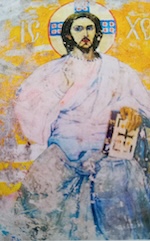
A painting of the portrait of Jesus: acting on the divine with man and God

Acting on the Divine #13

“God became man so man could become God.”

{The 4th century Church Father Athanasius, the Great, (Inner Christianity, Smoley, p. 80)}

What might seem impossible, is not so! You can choose to become, and act, like Jesus with your faith in His divine hope and love. Whatever you can think of doing in His Name, you can do and impart to others. It just requires both your trust in yourself and your believe in your God.    

Jesus replied, “If you can?..   Everything is possible for one who believes”. 

In Matthew and Luke (Matthew 10; Luke 9, 10) Jesus sent out His disciples, just as He was sent, “and gave them authority to drive out evil spirits and to heal every disease and sickness” (Matthew 10: 1 NIV). He makes it even more clear a few verses later, “As you go, preach this message: the Kingdom of Heaven is near (also translated as ‘here’). Heal the sick, raise the dead, cleanse those who have leprosy, drive out demons” (Matthew 10: 7, 8 NIV).

Yes, you have permission to act and heal others.

The exact quote is in John 14:12:

“Very truly I tell you, whoever believes in me will do the work(s) I have been doing, and they will do even greater things than these, because I am going to the Father.” 

…Christianity has always taught, there is way out of the fallen state (the fall from grace), a means of overcoming the world. For the outer Christian, it comes at death and involves salvation. For the inner Christian, it can come in life, and it has to do with gnosis (Self- Knowledge of the Divine). (Smoley, p.65)

Why wait for Death when you can Know and Act on the Divine Now!

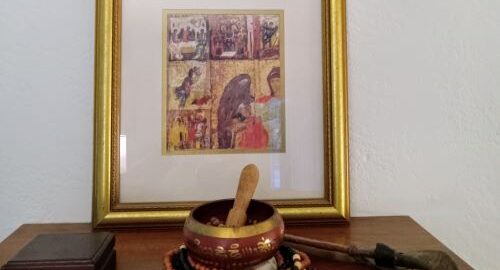
A framed old world artwork with a bowl and a wooden stick inside of it. A stone etched with the word "Faith".

The Difference Between Life and Death #12

The difference between life and death is only one breath.

For such a small difference, we seem to expend an inordinate amount of energy debating about the transition from life to death and the afterlife. For religious traditions this transition is explained as a matter of faith.

However, science and philosophy have made inroads into our understanding of the afterlife. Does out “consciousness” (soul) continue to exist after our physical body dies? Some of our best minds are trying to find a factual basis for what religions accept as a tenet of faith.

Quantum physics seems to be building a bridge between matters of faith and science. In one study, our linear sense of time does not exist. In another, our reality is only an illusion among an infinite number. And in yet another, our consciousness does not dissolve at death, but continues to exist in multiple states all at once and is entangled to interact across vast distances. With these scenarios life and death, as we know it, does not really exist as separate states because we already exist and interact independently and interdependently from these two limited states. We are, in a sense, infinitely greater than what we believe—we are like God—omnipresent!

So why do we expend so much of physical and emotional resources anticipating and fearing a moment of change that is just “one breath” away. Let it go (and let God), you already exist!

What are the perspectives on death, the process, and afterlife concepts of the major religions?

Across these traditions, prayers and rituals serve to provide comfort, guidance, and spiritual support to the dying and their loved ones, helping them navigate the profound transition between life and death with grace and dignity.

Mystical traditions within Christianity, Islam, Buddhism, Hinduism, Taoism, and Confucianism offer diverse perspectives on the transition between life and death, along with accompanying prayers and rituals.

  1. Christianity:

Christian mystics often emphasize the soul’s journey towards union with God. Prayers and rituals focus on preparing the soul for death, seeking forgiveness, and entrusting the departing soul to God’s mercy. Practices like the Last Rites or Sacrament of the Sick are performed to comfort and prepare the dying.

  • Death: In Christianity, death is seen as the separation of the soul from the body. It is often viewed as a passage to the afterlife.
  • Process: The process of dying is often seen as a time of preparation for the afterlife, where believers may reconcile with God and others.
  • Afterlife: Christianity teaches the concept of heaven, where the righteous will experience eternal joy and communion with God. There is also the concept of hell, where those who have rejected God will experience eternal separation from Him.

  1. Islam:

Sufi mystics in Islam view death as a transition from the material world to the spiritual realm. Prayers and rituals focus on surrendering to the will of Allah, seeking forgiveness, and preparing the soul for judgment. The recitation of Quranic verses and dhikr (remembrance of Allah) are common practices during the dying process.

  • Death: In Islam, death is considered a transition to the afterlife. It is believed that the soul continues its journey after departing the body.
  • Process: The dying person is encouraged to recite prayers and affirmations of faith. Family and community play a significant role in providing support during the dying process.
  • Afterlife: Islam teaches the existence of paradise (Jannah) for those who have lived righteous lives and followed the teachings of Islam. Hell (Jahannam) is believed to be a place of punishment for those who have rejected God or committed grave sins.

  1. Judaism:

In Judaism, mysticism is primarily expressed through the teachings of Kabbalah. While Judaism emphasizes the sanctity of life and the importance of living according to Jewish law (Halakha), mystical traditions offer insights into the nature of the soul and its journey before and after death.

  • Death: In Judaism, death is viewed as a natural part of life. It is seen as a transition to the afterlife rather than an end.
  • Process: Jewish tradition emphasizes the importance of honoring the deceased and providing comfort to the bereaved. Rituals such as sitting Shiva are observed to mourn and remember the deceased.
  • Afterlife: While beliefs about the afterlife vary among different Jewish traditions, there is a belief in Olam Ha-Ba, the World to Come, where the souls of the righteous will experience closeness to God.

  1. Hinduism:

Hindu mystics believe in the concept of reincarnation, where the soul continues its journey through multiple lives. Prayers and rituals focus on helping the departing soul navigate the afterlife and ensuring a favorable rebirth. Practices such as reciting sacred texts, performing puja (worship), and conducting funeral rites like cremation are important.

  • Death: In Hinduism, death is seen as a natural part of the cycle of reincarnation (samsara). It is believed that the soul continues its journey through multiple lives.
  • Process: The process of dying is considered important, and family members often play a role in assisting the dying person and performing rituals to ensure a peaceful transition.
  • Afterlife: Hinduism teaches the concept of moksha, liberation from the cycle of reincarnation. Achieving moksha involves spiritual enlightenment and union with the divine.

  1. Buddhism:

Buddhist mystics often see death as a natural part of the cycle of rebirth (samsara). Prayers and rituals aim to guide the dying through the process of death and rebirth, offering support and creating positive karma for their future existence. Practices like chanting mantras, meditation, and visualizations of peaceful deities are common.

  • Death: In Buddhism, death is viewed as a transition to another state of existence within the cycle of samsara. It is not seen as an end but rather a continuation.
  • Process: Buddhism emphasizes the importance of preparing for death through spiritual practice and mindfulness. Practices such as meditation and contemplation are encouraged.
  • Afterlife: Buddhists believe in the cycle of reincarnation, where individuals are reborn based on their karma. The ultimate goal is to achieve enlightenment (nirvana) and break free from the cycle of suffering.

  1. Taoism:

Taoist mystics see death as a return to the Tao, the ultimate reality. Prayers and rituals aim to harmonize the departing soul with the natural order and facilitate its transition to the next phase of existence. Practices like meditation, offering incense, and reciting Taoist scriptures are common.

  • Preparation for death: Taoist teachings encourage practitioners to cultivate inner tranquility, simplicity, and spontaneity in preparation for death. Practices like meditation, qigong (energy cultivation), and aligning with the flow of the Tao help individuals achieve a sense of acceptance and peace.
  • Transition between life and death: In the perspective of Taoism, the significance of death is the process towards life in a different dimension. Life and death are seen as a unity that are inseparable and human beings will experience the from nature back to nature cycle.
  • Prayers and rituals: Taoist rituals aim to ensure a peaceful transition for the dying and facilitate their journey to the afterlife. Practices may include reciting sacred texts, burning incense, and offering prayers to deities like the Jade Emperor or the Three Pure Ones.

  1. Confucianism:

 Confucian mystics emphasize the continuity of familial and social bonds even after death. Prayers and rituals focus on honoring ancestors, maintaining family cohesion, and ensuring the well-being of the departed in the afterlife. Ancestor worship, offering sacrifices, and observing mourning rites are important practices.

  • Preparation for death: Confucian teachings emphasize the cultivation of moral virtues, familial harmony, and social responsibility. Preparation for death involves living a life of integrity, contributing to the welfare of society, and passing on moral values to future generations.
  • Transition between life and death: Confucian mystics emphasize the continuity of familial and social bonds across generations, even after death. They stress the importance of honoring ancestors and maintaining filial piety.
  • Prayers and rituals: Confucian rituals for the dead focus on ancestor worship and expressing gratitude for their guidance and blessings. Practices include offering sacrifices, burning incense, and conducting mourning rites according to tradition.


Time May be an Illusion

We Live in a Simulation

Quantum Entanglement

Common Beliefs #11

Common tenets among major religions often revolve around themes of morality, spirituality, and the purpose of existence. While each religion has its unique beliefs and practices, there are some overarching principles that many share:

  1. Belief in a Higher Power: Most religions believe in the existence of a divine being or beings, such as God, gods, or a universal energy.
  2. Ethical Behavior: Virtues like compassion, honesty, justice, and kindness are emphasized across many religions as fundamental to leading a good life.
  3. Golden Rule: The idea of treating others as you would like to be treated is present in various forms in many religious teachings.
  4. Life After Death: Many religions have beliefs about an afterlife, whether it’s reincarnation, heaven and hell, or other spiritual realms.
  5. Sacred Texts: Most religions have texts that are considered holy or authoritative, which contain teachings, stories, and guidance for followers.
  6. Prayer and Rituals: Practices like prayer, meditation, worship, and rituals are common across religions as ways to connect with the divine and express devotion.
  7. Community and Fellowship: Being part of a religious community provides support, guidance, and a sense of belonging for many followers.
  8. Purpose and Meaning: Religions often offer explanations for the purpose of human existence and the meaning of life, helping followers find a sense of direction and fulfillment.
  9. Morality and Ethics: Many religions provide moral frameworks and ethical guidelines to help individuals navigate moral dilemmas and live virtuously.
  10. Unity and Harmony: While there are differences among religions, many emphasize the importance of unity, peace, and harmony among people of different faiths.

These principles serve as foundations for the beliefs and practices of billions of people around the world, guiding their understanding of the divine, their relationships with others, and their journey through life.

Unity vs. Duality #10

I have often wondered why our emotional brains process information by creating dualities: good and evil, love and hate, life and death, fear and courage, faith and doubt, hope and despair, action and inaction.

We do so because it is easier for our emotional and lazy mind to create a dichotomy, rather than understanding our universe as a whole– while holding these aspects as just parts.

In various religious traditions, there is an understanding that behind the apparent dualities of existence lies a deeper unity or interconnectedness. This unity might be expressed in diverse ways: as the oneness of God, the interconnectedness of all living beings, or the underlying unity of the cosmos.

  1. Buddhism:
    • “Form is emptiness, emptiness is form. Emptiness is not separate from form; form is not separate from emptiness.” – Heart Sutra
  1. Hinduism:
    • “The wise see the same Self in all beings, and all beings in the same Self.”  – Bhagavad Gita
  1. Taoism:
    • “The Tao that can be told is not the eternal Tao; The name that can be named is not the eternal name.” – Tao Te Ching
  1. Christianity:
    • “I am the vine; you are the branches. If you remain in me and I in you, you will bear much fruit; apart from me you can do nothing.” – John 15:5 (NIV)5
  1. Judaism:
    • In the words of the Talmud: “The Holy One, blessed be He, said to Israel: You have made Me one in the world, so will I make you one in the world.”
  1. Sufi Islam:
    • “Out beyond ideas of wrongdoing and right doing, there is a field. I’ll meet you there.” – Rumi

These quotes from various religious texts illustrate the concept of oneness within the context of duality, emphasizing unity, interconnectedness, and the transcendence of apparent distinctions.